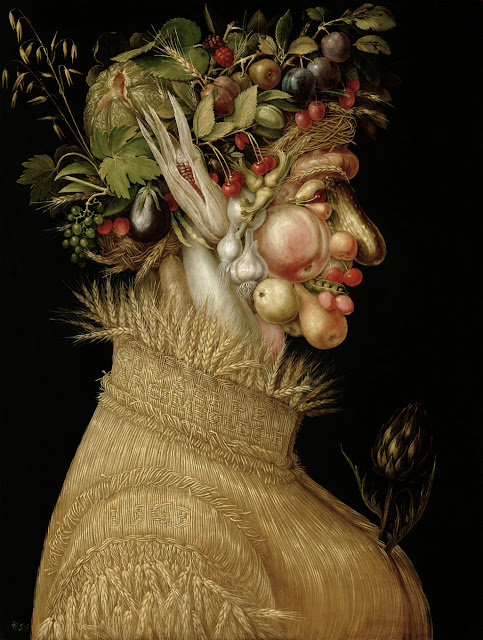
Arcimboldo’s Summer

Arcimboldo’s Summer
Giuseppe Arcimboldo (1527-1593) was the master of these pre-surrealist paintings of figures formed of grouped objects (not always food).

Thursday, 2 May 2013

Banana Appeal

Have you ever been impatient to eat a banana and selected a fruit that you knew wasn't quite ripe yet? And then, when you peel it and bite into it, you discover what you knew would happen all along: the flavour lacks sweetness and is chalky and disappointing.

Well, there was a time when that would not have happened. Up until the mid 20th Century the variety of banana consumed all over the world was called Gros Michel, and these little rascals were as delicious when eaten green as they were ripe.


Unfortunately Gros Michel (which I'll loosely translate as Fat Michael or Big Mike) was wiped out, completely in commercial terms, by a plague of fungus (Fusarium oxysporum commonly known as Panama disease — a relative of Dutch Elm disease).

So the second best variety stepped up and came into commercial use. This is called the AAA Cavendish and it is the variety that you (and I) are eating today,

The "AAA" isn't a designation of quality. Rather it refers to the fact that the Cavendish is a hybrid with three sets of chromosomes (instead of the usual two). It is called a triploid. The A stands for "acuminata" because all three of the Cavendish's ancestors come from the Musa acuminata subspecies. 

The other subspecies of the banana family is Musa balbisiana and cross pollination with M. acuminata has led to the AAB triploids which represent the Pacific plantains.

Enough science. Now for the dramatic bit.

Just as Gros Michel was wiped out by a fungus, Cavendish is now under threat, by a villain called black Sigatoka. (If ever there was a villainous name, that's one.)

Experiments are under way to make Cavendish resistant to the fungus, either by genetic engineering or through breeding in resistance by recreating it from its wild ancestors.

Neither line of research is showing much success. 

So keep your fingers crossed, or we may not have any  bananas, even inferior Cavendish bananas to eat, green or ripe.

However it's worth noting that the superior tasting Gros Michel variety still exists. It's a rarity, but it's out there...

Maybe it's time for Big Mike to make a comeback.
 
(Most of the information for this post derives from an excellent article in the 20 April 2013 New Scientist 'Go Bananas' by Bob Holmes.)

(Image credits: the green and yellow bananas are from Boing Boing. The heaped bananas are from Wikipedia. The stages of ripening bananas 1-7 are from Carla Golden Wellness. The close up of a pile of bananas is from Scientific American. All these sites provide some interesting reading on the subject. The Velvet Underground cover is from Trending Trademarks, which has some interesting reading on a copyright dispute between the Velvets and the Warhol estate.)


Tuesday, 26 March 2013

You're a Cute Tomato

It’s not easy getting a decent tomato in this country. I haven't had a regular supply since my neighbours who grew their own moved away (how thoughtless).

Tomatoes sold still on the vine sometimes have more flavour than the pre-picked kind. Sometimes. 
 
But the standard of taste is so generally low that I usually just buy on the basis of cost.

Tomatoes in the UK are pricey. Just how pricey was hammered home the other day when I needed a couple of tomatoes for a recipe. (All right, to tart up a potato dish before serving it, actually.)


So I splashed out on a couple of speciality Marmonde tomatoes from Waitrose.


They certainly looked nice. Unfortunately they didn't really have any flavour.


And these two modest sized tomatoes cost more (£1) than a punnet of my usual tomatoes: Sainsbury’s Basics All Shapes, All Sizes, which are presently retailing at 81p for 450g.


The Sainsbury’s tomatoes are my current tip for the best deal. They make a splendid pasta and pizza sauce (recipe here).


Their flavour isn’t exactly superb, but they are about as good as the expensive Marmonde ones from Waitrose, at least on this occasion.


Maybe I can get my new neighbours to start growing them...


(Image credits: The groovy looking tomatoes at the top (actually Marinda) are from Natoora; the Sainsbury’s punnet is from My Supermarket. The Waitrose Marmonde is from the Waitrose website.)

Sunday, 23 September 2012

Tesco Spanish Red Grapes — Yum

I love grapes. Let's be honest, I'm addicted to grapes. They've got to be seedless. They've got to taste great.

And I get through a couple of kilos a week.

Okay, let's be totally honest. I get through more. But we need not dwell on my excesses here.
 
Grapes can be very pricey, if you buy them at Waitrose or M&S. But Sainsbury's and Tescos both sell budget grapes — just as nice as their premium ones, as far as I can tell — for about a quid per 500 grams.

The quality of these, and their exact nature, depends on what is available to the supermarkets' buyers at any given time. So sometimes they have red grapes. Sometimes they have green grapes. They come from various countries, and usually they're tasty.

Occasionally they're not so great. Recently we've had a run of green grapes from Greece (try saying that three times, fast) and they've been, to be honest, pretty dodgy. They're squishy, a bit sour, and are shaped like miniature water melons. I recommend you avoid.

Both Sainsbury's and Tescos were recently selling these, and I was getting a bit discouraged with my whole grape-devouring policy.

But then Tescos came up with 'Special Purchase' Spanish seedless red grapes. They looked terrific and so I snapped up several packs, took them home and started eating. Absolutely delicious. Sweet, crisp, wonderful.

I went back and bought a couple of bags full (this blog is called Greedy Eater).

These grapes are slightly more expensive than the usual bargain ones — 400 grams instead of the usual 500 grams for a quid.

But who cares. Get them while you can! Great stuff.

Or should I say grape stuff.

(Memo to self — cut that last cheesy gag out of the food blog post.)

Saturday, 4 August 2012

Hot Taleggio Tip


What is taleggio? It is a delectable Italian cheese which manages to combine an egg-yolk richness with a winey astringency. In short: yum. 

Here is a very quick recipe: pull the stems out of large mushrooms, fill the caps with olive oil and a dab of tarragon vinegar. Cover with slices of taleggio. Bake the mushrooms. Enjoy. 

I'll add another taleggio recipe later.
 
Meanwhile, I want to give you some advice about buying taleggio. 

First of all, buy it. And eat it. 

Secondly, the best deal on taleggio is currently at Tesco’s. This fine supermarket sells small (200g) blocks of the cheese in proper paper wrapping (no sweaty plastic here, thank you) for, currently, £10 a kilo.

By comparison, Sainsbury’s charges a very reasonable £11.50 and Waitrose north of £16.
The reason I want to tell you about this is because Tesco’s has a special 3-for-2 offer on certain cheeses. Including taleggio. 

Go and buy some. Now. And I'll give you that other recipe.

Thursday, 20 May 2010

Young, Nubile Trees: in Search of Organic Orange Juice

A few years ago I was shooting a short film on a houseboat in Docklands, in London. I had written the script and I was also the producer. The demands of my producer job pretty much consisted of me holding blackout cloths to cover the boat windows during shots (to simulate night) and feeding the cast and crew. In the latter role, I excelled. I'd prepared various meals and in the course of the day I sent our runners get additional victuals from the nearby Waitrose. We had two runners, a guy and a girl, who were a study in contrasts. I had brought some wine with us for a party at the end of the shoot and I asked the guy to go to the local Waitrose and buy some posh cheese to go with it. I gave him a handful of cash and sent him off, only to receive a perplexed phone call. He was in Waitrose and he'd asked them and they didn't sell any Posh Cheese. He thought Posh Cheese was a brandname. The girl runner, however, was incredibly good. I sent her off with a long list of things to get for lunch and she came back with everything on the list and she'd managed to buy it all at startlingly low prices. Clever runner. I was particularly impressed with the organic orange juice which she'd managed to find, at less than half the usual cost. It turned out to be made from concentrate, which was fine with me, and it was my first encounter with this bargain organic juice option. It was what they called longlife juice, pasteurised by a heat process which lent it its longevity. And it was delicious. After that I made a point of looking into organic juices prepared from concentrate. They were often (though not always) dramatically less expensive than the freshly squeezed versions and often tasted just as good. Ironically Waitrose, who had introduced me to this concept, were soon off my shopping list. Their version of the juice was substantially more pricey than its competitors and, more to the point, wasn't 100% organic. It also contained "natural fragrances" which presumably are supposed to improve the flavour. Personally, I tend to think they make your juice taste like an orange scented air freshener has been dipped in it. To my mind Sainsbury's version is much superior, with nothing but organic orange juice in the carton. It's also a better price and features a priceless description on the back which declares that their oranges are grown on "young, nubile trees". Someone needs to tell them that nubile means "marriageable". Nonetheless, this is currently my supermarket juice of choice.

Tuesday, 20 October 2009

Alert — Delcious Potatoes Found at Waitrose!

I invariably eat organically grown potatoes, partly because I'm paranoid about what's sprayed on my food, partly because I'm concerned about conventional farming techniques ravaging the landscape, and also partly because they often (not always) taste a damned sight nicer. The most consistently pleasant tasting organic spuds available at a supermarket in recent years have proved to be Sainsbury's Lady Balfours (available in 2.5 kg bags for about £2.70). When they are good, they are very good; sometimes they are no better than average. But any of the supermarkets will occasionally turn up trumps and today, because Sainsbury's was a long hike away, I dropped into my local Waitrose to buy ingredients for my Ligurian pasta and pesto specialty, in which both green beans and potatoes also feature prominently. I chose a bag with blue livery, containing 1.5 kg of Waitrose organic new potatoes (£1.99). I put them in the steamer and, when they were cooked, took one out, sliced it, let it cool and treated myself by dipping it into the Tesco's pesto which I'd also bought. It was a revelation. A lovely sweet, rich, buttery potato. With a nice yellow colour, too (my Dad always revered yellow spuds as more tasty than their white brethren). Now, as a natural product, potatoes can and will vary from batch to batch (hence the inevitable inconsistency with the otherwise admirable Lady Balfours) so if you are going to get the same wonderful potatoes on your plate you need to get the same batch and type. The ones I bought are marked "Nicola" for the variety, "Cambs UK" for their origin. They are dated "Display Until 22 October" and "Best Before 25 October". They also feature these cryptic markings: PP1 11:00 236/M. Now you know! Happy hunting. Or digging.

Monday, 21 September 2009

Jim Harrison’s Pizza Sauce

I first came across Jim Harrison through the writings of Tom McGuane, my favourite novelist. Like McGuane, his old friend Harrison is a novelist and screenwriter. He is also a well respected poet. But what we're interested in here is his food writing, which is very entertainingly on display in his volume The Raw and the Cooked. This recipe is adapted from one in that book and it is the most delicious simple sauce I've ever cooked.

Pizza Sauce of the Gods

Originally intended to go with meatballs, and adapted by me for pasta, this makes a world class pizza topping. Cook for about 30 to 35 minutes and finish on top of a blind baked pizza base for 10 minutes. Use 500g tomatoes and there will be enough sauce to completely cover one pizza base generously and two frugally. You don't necessarily have to add cheese or anything else (eg chorizo) to the pizza topped with this sauce (although they will go wonderfully), because it's delicious and classy as is.

Pour a liberal amount of good olive oil into a baking pan.

Slice tomatoes of any size in half and place them in the pan. (Don't bother removing seeds or any of that nonsense.)

(Use, for example, 250g of plum or cherry tomatoes per person.)

Sprinkle them liberally with chopped garlic and fresh basil and thyme. (Lots of all of these. I've used about 10 cloves of garlic to good effect.)

Cook for about 40 minutes in a hot oven.

If you want a smoother sauce, chop the cooked tomatoes, garlic and herbs roughly with scissors so you end with the desired consistency. If you're using smaller tomatoes this isn't necessary. Pour over cooked pizza base or pasta and serve.

Goes very nicely with a simple salad of romaine lettuce with a garlicky vinaigrette.